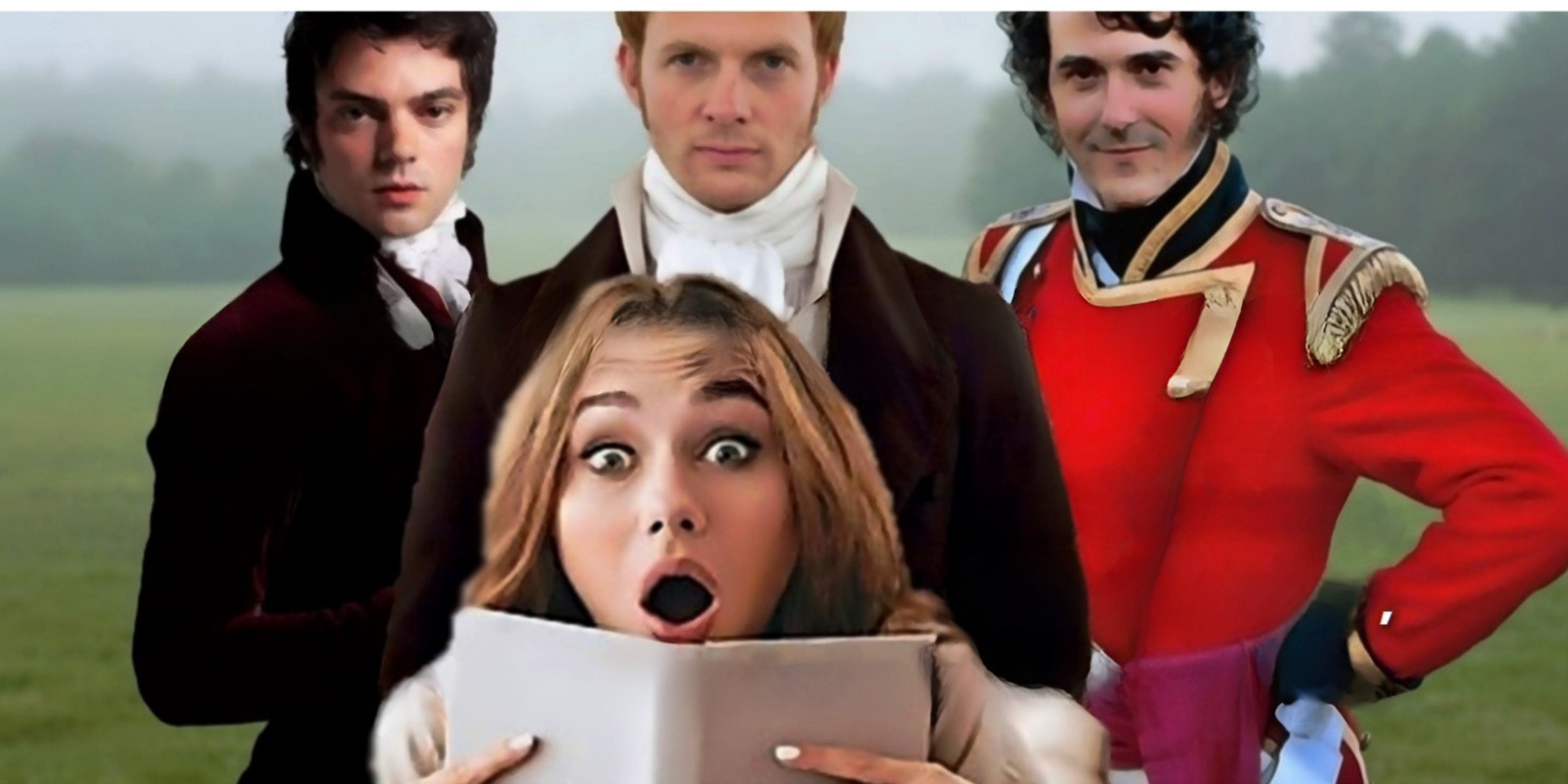
““While most readers will agree that Mr. George Wickham, in Pride & Prejudice, and Mr. John Willoughby, in Sense & Sensibility, are portraits of rogues with their puckish smiles and rakish behaviors, few would readily align Captain Wentworth with this assembly of “bad boys”. He stands apart from others because, in the end, he is the man most beloved by Anne Elliot.””
Mindy Killgrove-Harris, editor of Pride & Possibilities, dissects Captain Wentworth’s behaviors during yet another re-read of Austen’s Persuasion. Observing his actions without the interference of Anne Elliot or the narrator, she analyzes whether he is the heroic character most make him out to be or really a bit of a rogue.
Each time I sit down and embark upon another reading of Jane Austen’s novels, I challenge myself to approach the endeavor in a new way. Sometimes, I wish to investigate a particular sentiment that other readers have encountered, and I’ve missed. On other occasions, I seek to develop a clearer understanding of character motivations. Recently, when a group I participate in decided to conduct a slow read of Austen’s Persuasion, I vowed to approach the novel with an eye focused on the autumnal accents. So many scholars describe this work as one that is rich in seasonal undertones, and I was obliged to see if I could find them myself. But, interestingly enough, during my perusal of the text, I found something, besides references to the weather and the changing of seasons that had escaped my notice before. As I read, I started to see Captain Frederick Wentworth as less of a long-suffering, stoic hero and more like an angry, spurned lover, who treated Anne Elliot with the same discourtesy that was offered by others in the book.
Beginning with an Insult
For anyone who has loved and lost, the story of Persuasion is captivating. A young pair, Anne Elliot and Frederick Wentworth, spent six months falling in love only to be torn apart by the interference of those closest to Anne—her father, Sir Walter Elliot, and confidante, Lady Russell. Once the engagement between them ended, Frederick sailed away to seek his fortune and Anne remained at Kellynch Hall where she stewed in her misery. But, after eight long years of separation, the couple find themselves thrown together once more.
The very first words attributed to Anne Elliot, our heroine, appear in chapter three when she says, “The navy, I think, who have done so much for us, have at least an equal claim with any other set of men, for all the comforts and all the privileges which any home can give. Sailors work hard enough for their comforts, we must all allow.” So, it seems that even though she could no longer see Frederick Wentworth or claim his affection, she did think of him, and those like him who served in the navy, admirably.
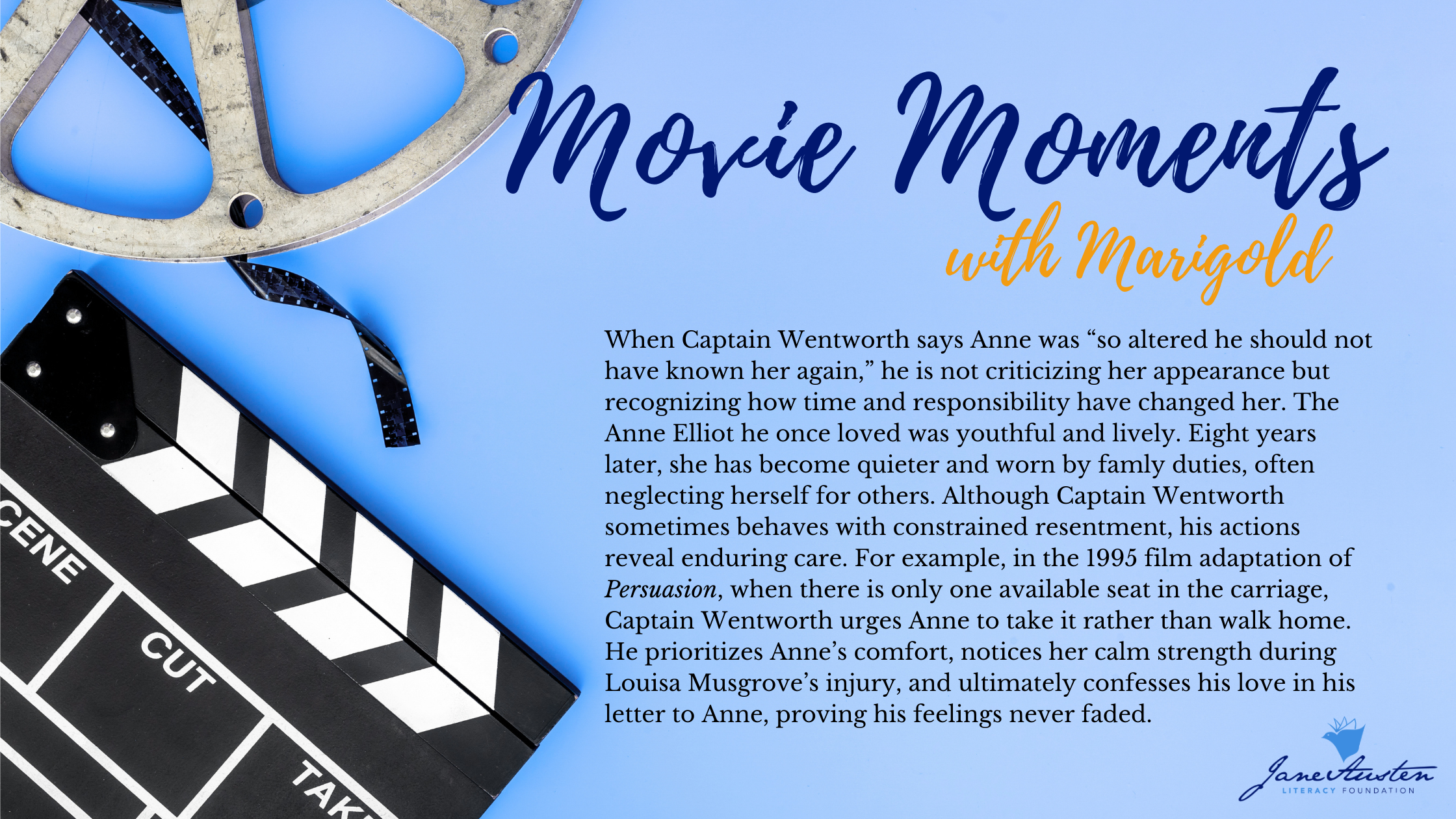
But, when Frederick himself returns to town and dines in the company of those who know Anne best, he does not treat her with such civility or kindness. In chapter seven, Anne’s sister, Mary Musgrove reports, “Captain Wentworth is not very gallant by you, Anne, though he was so attentive to me. Henrietta asked him what he thought of you, when they went away, and he said, ‘You were so altered he should not have known you again.’”
Anne acknowledges that there is some truth in his remarks, for she has changed a great deal since they last met, but that does not ease the sting of the barb.
The narrator tries to intercede and let the reader know that the hero did not mean to injure Anne’s feelings, but even this explanation feels like the cold comfort a person might give themselves after having their heart broken anew.
“Frederick Wentworth had used such words, or something like them, but without an idea that they would be carried round to her. He had thought her wretchedly altered, and in the first moment of appeal, had spoken as he felt.”
The trouble with this, and the statements that follow, is that while nurturing his own grieving feelings, Captain Wentworth thought nothing of Anne’s emotions. His anger at her was justifiable, but his quick remarks in this passage show something other than fury. Eight long years have elapsed, and yet, when he encounters her, he can only see blemishes and faults. He is still too hurt to consider the impact his words might carry and so, he speaks, without thinking that quite naturally Anne’s sister and friends will relay his discourteousness at the earliest opportunity.
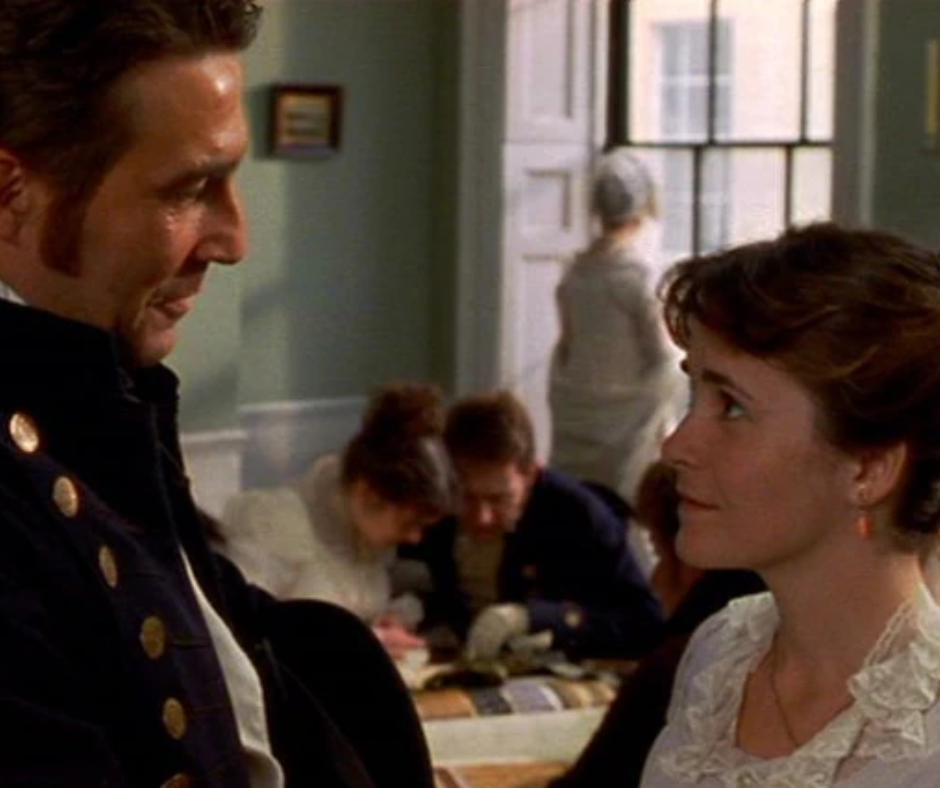
When their acquaintance is renewed, Anne Elliot finds difficulty in mustering the words to speak to Captain Wentworth. Actors Ciaran Hinds and Amanda Root are celebrated for their performances in the 1995 movie adaptation of Jane Austen’s Persuasion which is pictured here.
Seeking a Wife
Had Frederick Wentworth placed an advert in the newspaper proclaiming his wishes, they could not have been clearer than those that were dictated later in chapter seven.
“It was now his object to marry. He was rich, and being turned on shore, fully intended to settle as soon as he could be properly tempted; actually looking round, ready to fall in love with all the speed which a clear head and a quick taste could allow. He had a heart for either of the Miss Musgroves, if they could catch it; a heart, in short, for any pleasing young woman who came in his way, excepting Anne Elliot. This was his only secret exception, when he said to his sister, in answer to her suppositions:—
“Yes, here I am, Sophia, quite ready to make a foolish match. Anybody between fifteen and thirty may have me for asking. A little beauty, and a few smiles, and a few compliments to the navy, and I am a lost man.”
While he does not say he is wholly against Anne Elliot in this speech, the narrator tells the reader what is in his heart. He is seeking a wife here. Even though he must know that Anne Elliot is still in the neighborhood, he set his sights on finding a bride nearby Kellynch Hall. This really is a dreadful thought. So many of Captain Wentworth’s behaviors may be explained and even comprehended because they are contributed to the works of a distraught and frustrated man, but it is this act—coming to Anne’s neighborhood to find his bride—that is unpardonable.
Certainly, he cannot control where his sister or her husband Admiral Croft live. And, it might have even been rude to refuse to visit them at their new home at Kellynch Hall. Those circumstances are mostly out of Captain Wentworth’s control. But, when he is given the power to behave in an appropriate and gentlemanly manner, over the course of one dinner party, he not only says something disparaging about Anne Elliot’s looks, but he also proclaims his desire to find a wife. Again, the narrator intercedes and tries to temper these moments for the reader so that we will not think too harshly of our hero, but who can refrain from taking his words and actions at face value? Are we supposed to ignore, as Anne does, how these first few interactions are laced with painful jibes at the heroine’s expense?
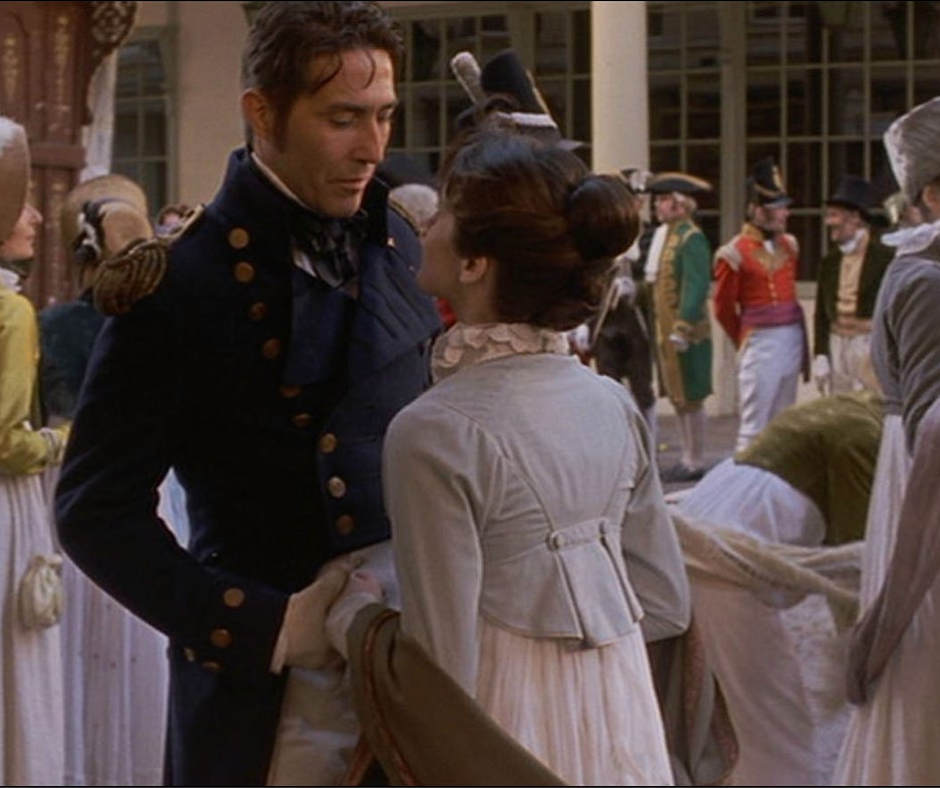
Captain Wentworth and Anne Elliot share a moment conversing in the 1995 movie adaptation of Persuasion. Even in a crowded room, they are pulled toward one another.
The Art of Wooing
The scenes that take place involving Captain Wentworth, Louisa Musgrove, and Anne Elliot in chapter ten have been interpreted in many ways. It is no wonder that the movie adaptations take liberties with these moments because in them, the true hearts of both Anne and Captain Wentworth are revealed.
It is during a moment of reprieve, when Anne is catching her breath, that she eavesdrops on a private conversation between Captain Wentworth and Louisa Musgrove. Not only does he allow his feelings for Anne Elliot to be known, but he expresses warm admiration for Louisa Musgrove.
“It is the worst evil of too yielding and indecisive a character, that no influence over it can be depended on… My first wish for all whom I am interested in is that they should be firm. If Louisa Musgrove would be beautiful and happy in her November of life, she will cherish all her present powers of mind.”
After overhearing this speech, Anne acknowledges that nothing could be plainer than a future alliance between Louisa and Frederick. As the others rejoin their party and Anne is forced to walk alongside them, she notices that Louisa and Frederick stick closely to each other’s sides and enjoy their own conversation without interruption.
A short while later, Admiral and Mrs. Croft appear and after sharing a word with Frederick, they invite Anne to join them in their carriage. This is another moment when Anne is quick to see her former love’s actions in a well-meaning light. She earnestly believes that Captain Wentworth entreated his relations to give Anne this break by inviting her to join them in the carriage. But—these are merely Anne’s conjectures. She does not know that Frederick asked them to take her along as a kindness.
Could he not have easily loaded her into the carriage so that he could continue wooing Louisa Musgrove without any interference? It must have been mighty awkward to have this lengthy conversation with Miss Musgrove while Anne, a woman he had praised sweetly during their youthful years, plodded along behind them, potentially listening to their entire discourse.
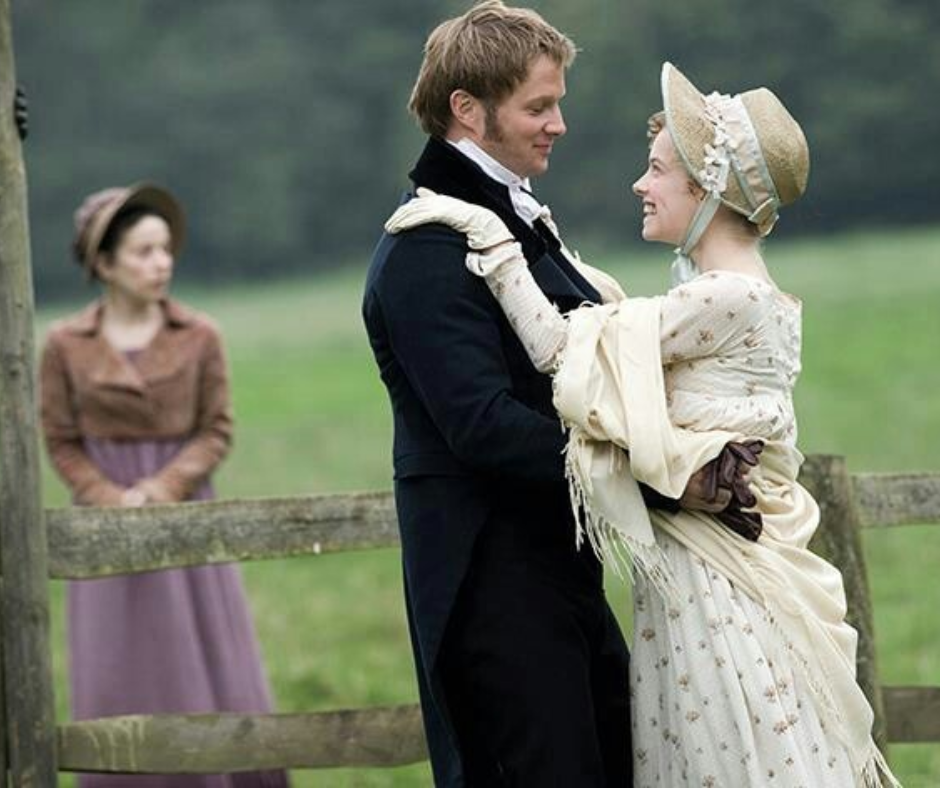
While searching for a future bride, Captain Wentworth flirts openly with Henrietta and Louisa Musgrove. Sometimes, as featured here in the 2007 adaptation, Wentworth does not spare Anne’s feelings and courts the ladies right in front of her.
Removing the Rose-Colored Glasses
Anne Elliot, and oftentimes the narrator of this book, elects to see Captain Frederick Wentworth as a paragon. He is right to point out how Anne has lost her youthful bloom because she has altered since they last met. And he sees that she is deposited in the carriage and sent away from the walking party because he must have truly recognized how fatigued she had grown. But it is while Anne rides with the Admiral and his wife that she is treated to an alternative perspective. Captain Wentworth has thrown himself completely into the hunt to find himself a wife and his efforts have not gone unnoticed.
“He certainly means to have one or other of those two girls, Sophy,” said the Admiral (near the end of chapter ten); “but there is no saying which. He has been running after them, too, long enough, one would think, to make up his mind. Ay, this comes of the peace. If it were war now, he would have settled it long ago.” Others, particularly Captain Wentworth’s family members, think that he means to marry one of the Musgrove girls soon and he is only taking his time in choosing because they are at peace; thereby allowing young men like Captain Wentworth the luxury to play the field.
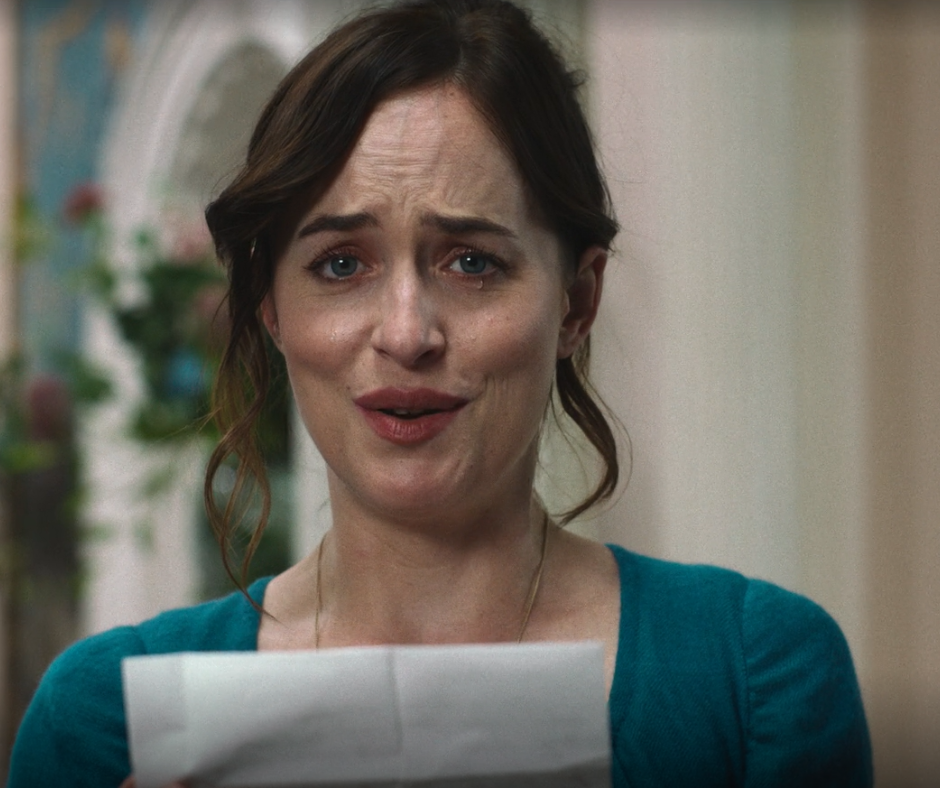
Anne Elliot, as portrayed by Dakota Johnson in the 2022 Netflix Adaptation, cries while reading the letter written by Captain Wentworth. It is not until this moment that she realizes his feelings mirror her own.
A Moment of Redemption
It is in chapter twenty-three where Jane Austen, through Captain Wentworth, aims to redeem all his follies by gifting the world, and Anne Elliot, with a lovingly written letter. Through this missive, Captain Wentworth assures Anne of his constancy. “You pierce my soul. I am half agony, half hope. Tell me not that I am too late, that such precious feelings are gone forever. I offer myself to you again with a heart even more your own than when you almost broke it, eight years and a half ago.”
In just those few sentences, Captain Wentworth captures the hearts of readers worldwide and renews his love affair with Anne Elliot. His pen is so powerful that it erases all which came before. The fact that he showcased hints of jealousy just a few chapters prior is forgotten. How he waited and listened to Anne express her feelings first to Captain Harville, speaking of how women love men much longer and with greater fortitude, before writing these lines is no longer necessary to the story. Even though he hurt her feelings, spent months flirting with the Musgrove sisters in front of Anne, and dared not express his lingering love for Anne until she had confessed her feelings first are all overlooked.
With this one single act, Captain Wentworth wins over Anne Elliot’s heart—one that already belonged to him.
But what about you, my fellow Janeite? Do you swoon over the words Captain Wentworth wrote to Anne? Do you forgive him all his errors in judgement because our heroine does so willingly? Or—do you think he only emerges as the hero in this story because Anne loves him truly and is convinced of his goodness?
Mindy Killgrove
Mindy Killgrove is a cozy mystery, historical fiction, and romance novelist. She is the creator of the Riley Roundtree Social Story Learning Adventure Series for children. Killgrove has penned more than fifty full-length novels, forty short stories, and dozens of children’s books. She lives in Orlando, Florida with her supportive husband and three rambunctious but beautiful children. She is an enthusiastic Janeite who is overjoyed to serve as the editor of the Pride & Possibilities newsletter and share her love of reading and writing with everyone she encounters.

Our Community - What's Coming Up in March
December brings holiday fun, celebrations, and cozy stories we can read while curled under a fluffy blanket.
Remember, your membership for only $10USD a month helps to support literacy programs around the world!
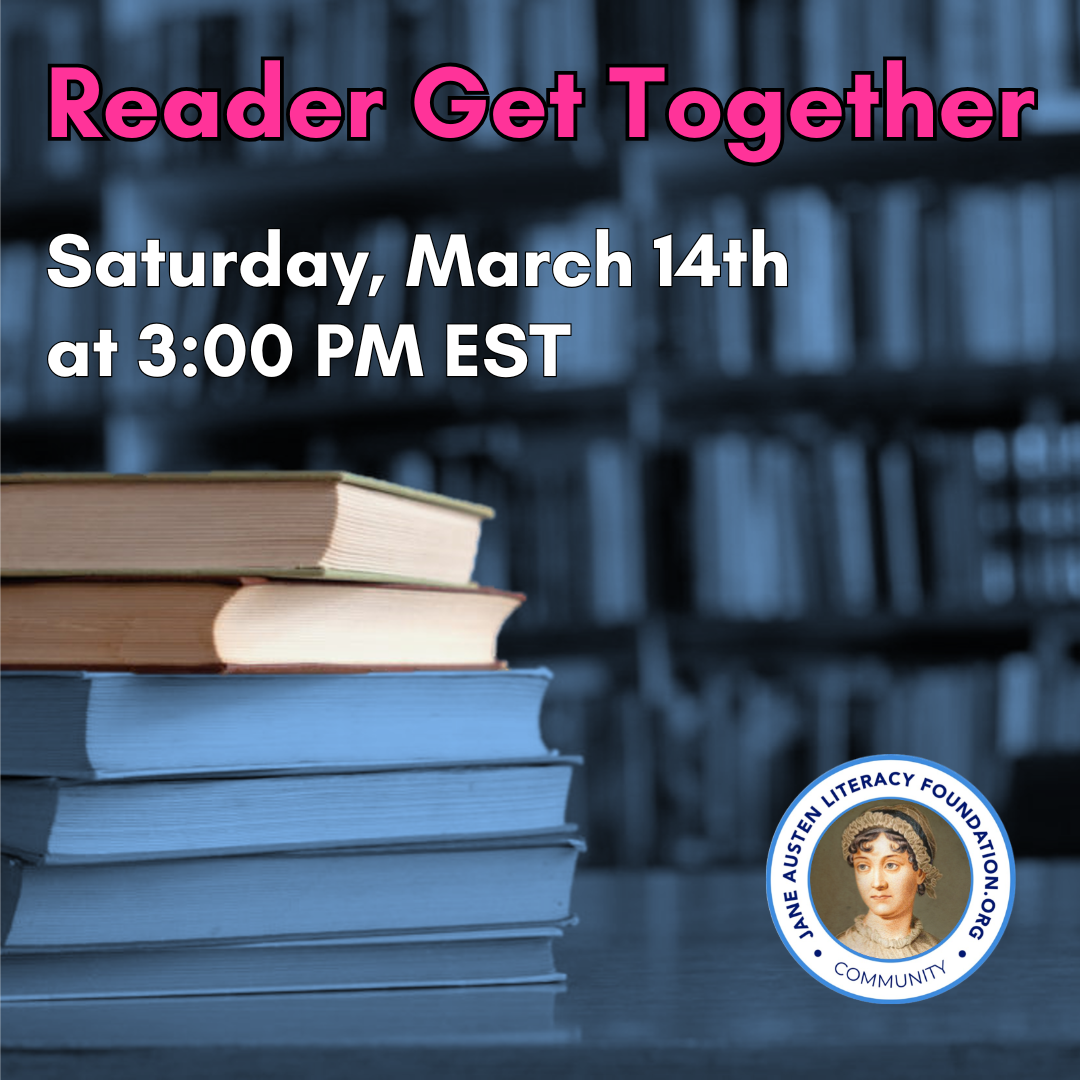
Reader Get-Together
Join us for a relaxed and welcoming reader meet-up! Bring a book you’ve read recently and would recommend to others. There’s no assigned reading — just thoughtful conversation, shared discoveries, and the joy of connecting with fellow readers.
✨ When: Saturday, March 14th
🕒 Time: 3 PM EST
💻 Where: On Zoom

Modern Persuasion Watch Party
Grab your favourite cozy drink and join us as we watch Modern Persuasion together and chat live on Zoom. It’s always such a delight to experience Austen-inspired stories as a community — sharing reactions, reflections, and plenty of bookish enthusiasm along the way.
✨ When: Sunday, March 22nd
🕒 Time: 3 PM EST
💻 Where: On Zoom
Both events are open to FRIENDS OF THE FOUNDATION members. We’d love to see you there!
And just for fun….
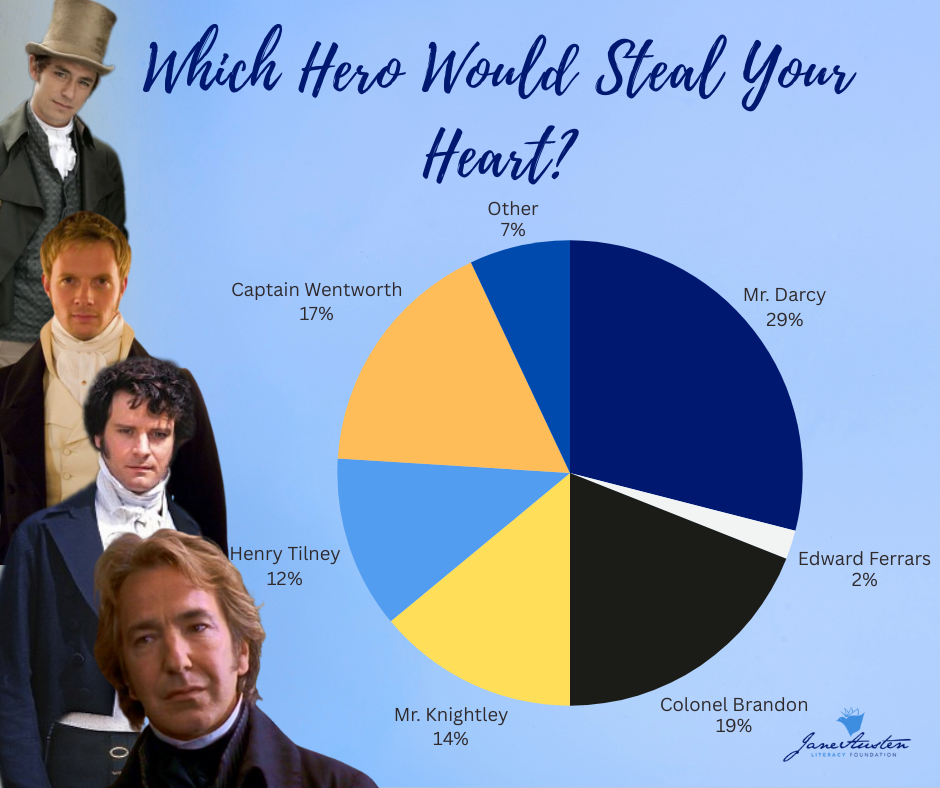
Results from a poll conducted in January 2026 by the Jane Austen Literacy Foundation in answer to the question: Which of Jane Austen’s Heroes Would Steal Your Heart? Special thanks to all the members of the Jane Austen Fan Club Facebook Group who shared their responses and thoughtful comments.