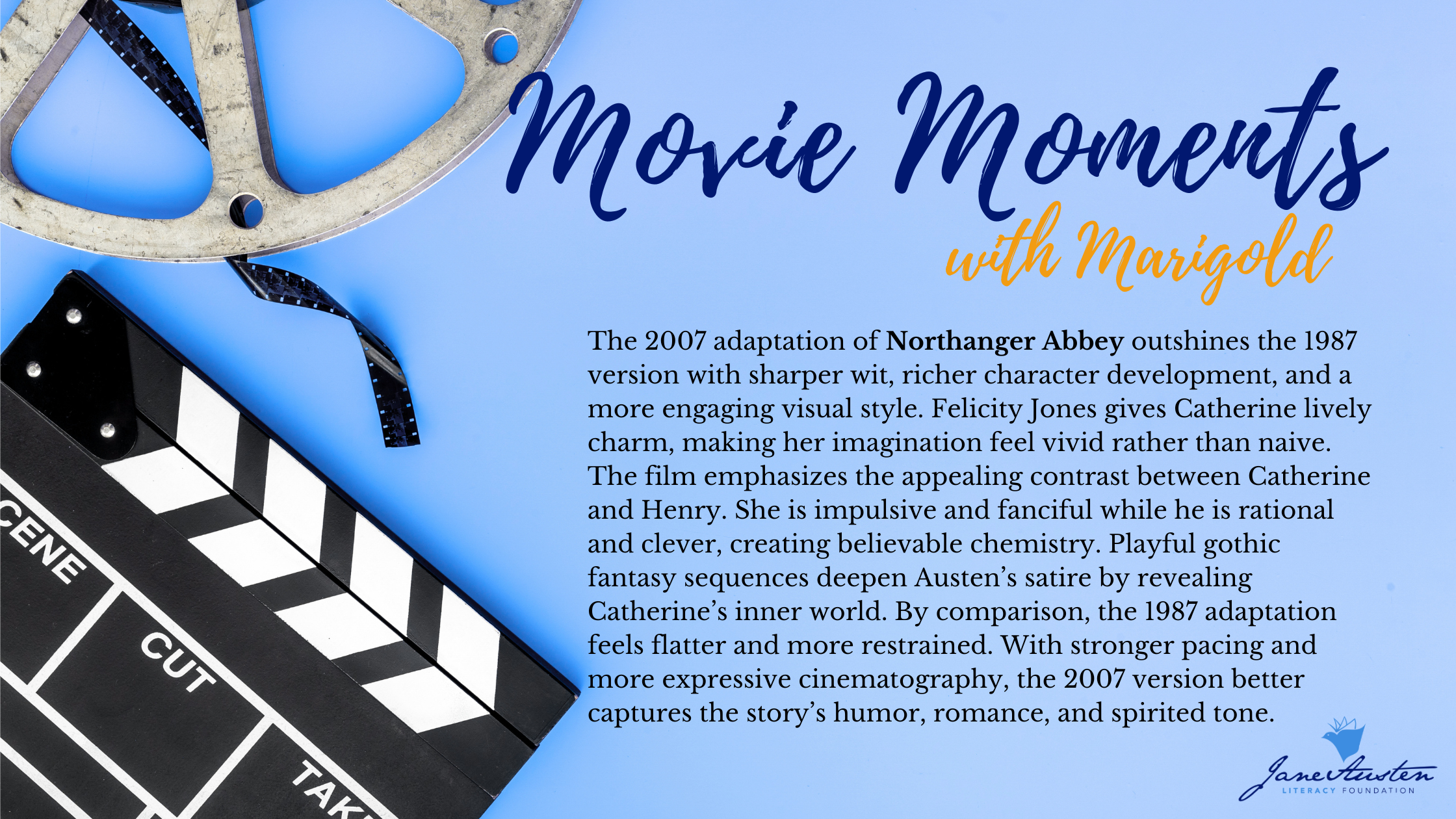
““The more a character is engulfed in literature, the more it influences the individual’s outlook and interactions with the world.””
Jessica Mancini, a University of Oxford graduate student specializing in Romantic Literature, analyzes Jane Austen’s use of auto-reflexive modeling of reading in Northanger Abbey.
Have you ever heard the expression: “You are what you eat?” How about this one: “You are what you read?”
In this academic article, Jessica Mancini explores the notion of readers who become so enthralled with what they read that they begin to see hints of fiction appearing in their everyday lives. The idea of “auto-reflexive reading” appears throughout this feature. It means to explain why Catherine Morland, a lover of gothic literature, begins to see elements from those treasured stories in her everyday life. Northanger Abbey isn’t just the home the Tilneys inhabit, but because of our heroine’s extensive reading and her active imagination, she fancies it to be the place where murders and mysteries await to be discovered.
I often find myself imagining a young Jane Austen reading The Mysteries of Udolpho as she walked the trails near her family’s home; with Cassandra by her side, did she fight the dilemma to read through the pages as quickly as possible or savor the delicious narrative? It is no secret that Austen was an enthusiastic reader. Her love of reading, and its influence on her wit and perception of society, evident as early as her juvenilia writings, reflected the reading culture of the Romantic period.
Romantic period writers were known to “offer models of reading which involve readers as well as writers” (St Clair 401), utilizing Britain’s newfound literary culture; Austen was among these reading model pioneers. Where Austen revolutionizes this modeling of reading is through auto-reflexivity— “writing that reflects upon its own composition” (Tanner 1712). In the case of Austen, her novels critique the complex relationship between a book and its reader. In Northanger Abbey, she masterfully juxtaposes the bookish protagonists Catherine Morland and Henry Tilney to show that there is certainly more than one way to read and interpret a story.
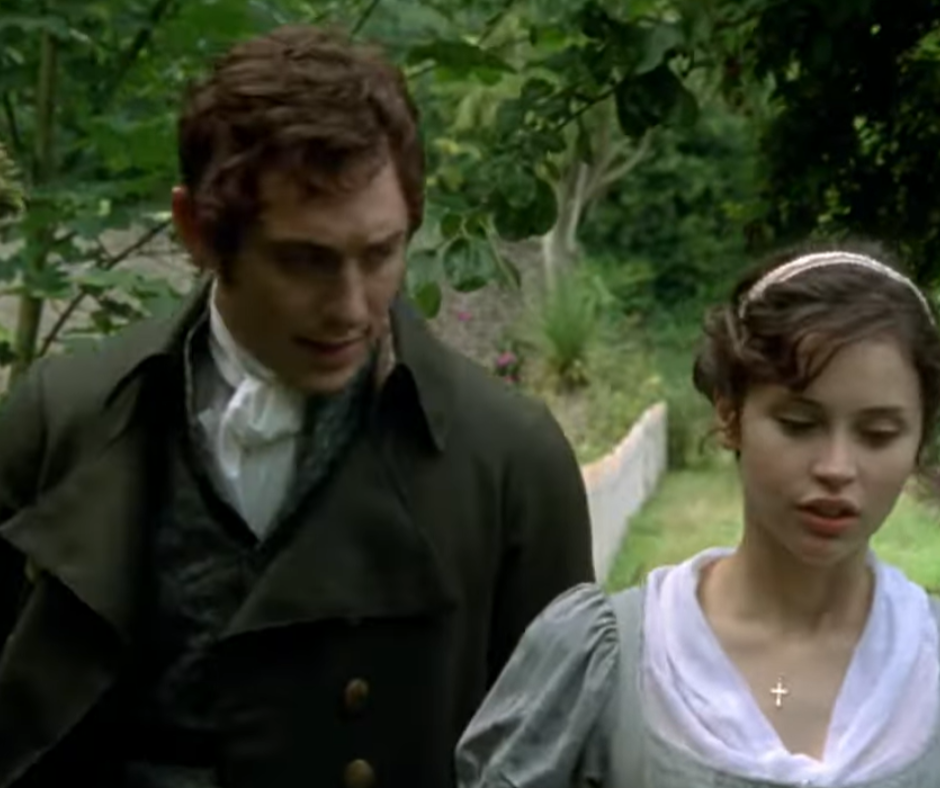
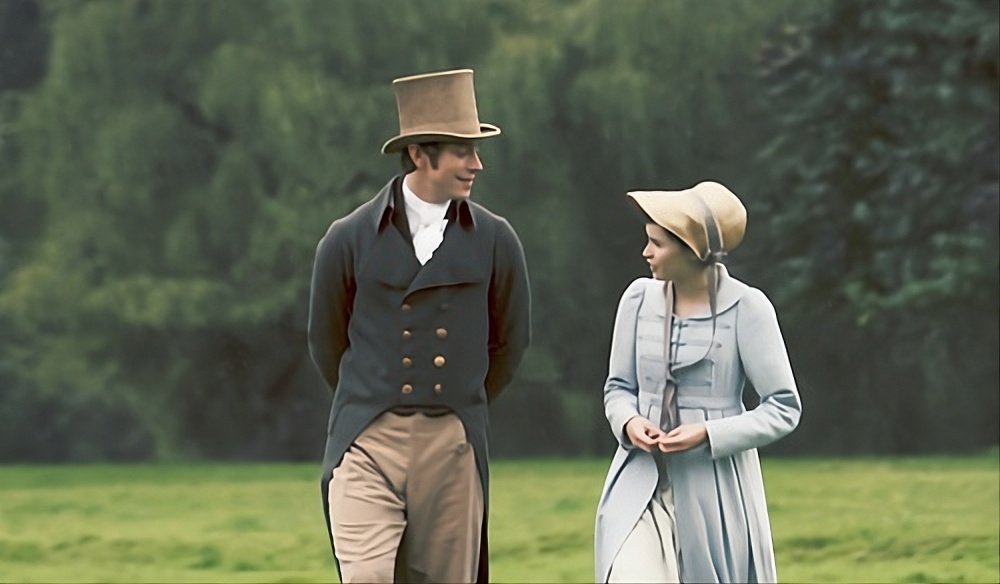
Mr. Henry Tilney and Catherine Morland, as portrayed by J.J. Feild and Felicity Jones in the 2007 movie adaptation, have much to discuss. While he approaches matters in a practical light, she has a more fantastical view of the world.
Whether the reader questions the book or submits to the trance of the narrative does not matter because either way, Austen’s critique of reading culture within the novels has achieved what it set out to do: it illustrates the complex relationship between a book and its reader, with the book containing more power of influence than anticipated. The genre of literature a character reads within a Jane Austen novel is, for better or worse, reflective of the individual's experience, interiority, and characterization. The more a character is engulfed in literature, the more it influences the individual’s outlook and interactions with the world. Therefore, a character’s life will reflect the genre they read, making that genre more appealing, and leading to a stronger connection with literature. This paradoxical cycle of reinforcement leads to characters subconsciously living the literature they most eagerly devour. This phenomenon can be seen in characters like Catherine Morland and Henry Tilney from Northanger Abbey.
Both characters are avid readers, and their content of choice guides their respective narratives because they internalize the themes and conventions of the literature they intake. Catherine attempts to live her gothic fantasies while she is at Northanger Abbey despite the irrationality of gothic plots. Similarly, Mr. Tilney’s education and rationality are exacerbated by his realist analysis of literature. The only way Catherine and Henry break the literary reinforcement cycle is by balancing imagination and realism as well as rediscovering the comfort and joys of their own lives, auto-reflexively encouraging Austen’s readers to adopt the same balance of literary escapism and appreciation of the present.
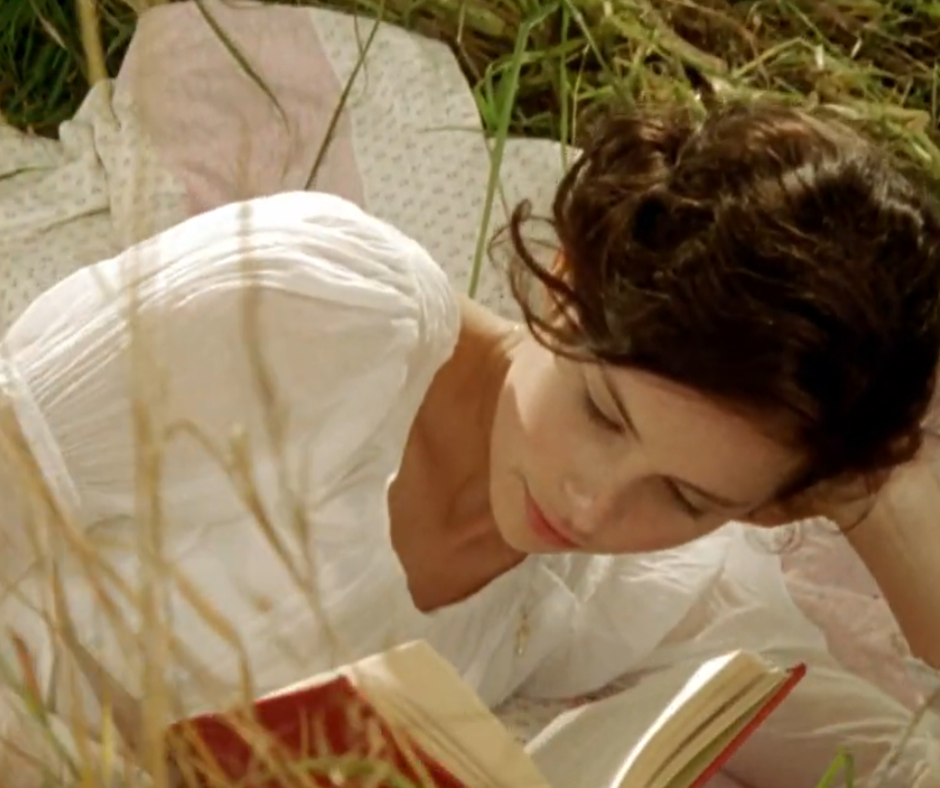
Catherine Morland learns about the world through an exploration of gothic literature. The reading she does in her spare time influences all areas of her life.
Catherine’s introduction, as early as the first page of Northanger Abbey, characterizes her as the quintessential gothic reader. She is naïve and has limited experience of the world, a world she has experienced and come to understand only through exposure to gothic novels. Catherine’s flighty tendencies imply she has no interest in being a valiant heroine. Her pleasure for mischief conveys her juvenile inclinations, and a lack of consideration for those the trouble is affecting. Catherine’s inattentive “stupidity” implies that the formulaic writing of a gothic novel would be intriguing to her, as she would not notice––or care––about the narrative’s predictability; she enjoys the simple straightforward plotlines.
In chapter seven of volume two the auto-reflexive modeling of reading is complimented by the satirization of the gothic tradition during Catherine’s night in the abbey. Catherine expresses that she is currently reading Ann Radcliffe’s The Mysteries of Udolpho (26). The novel from 1794 established the “now classic devices of Gothic romances” with Ann Radcliffe being a foundational inspiration for Austen (Britannica The Mysteries). The gothic devices Catherine reads surface in her life: Northanger Abbey serves as a secluded location, Henry Tilney is the ineffectual hero, and General Tilney is the tyrannical villain. Catherine sees herself as “the passive and persecuted heroine” (4).
Austen establishes Catherine’s perception as the gothic heroine when she first arrives at Northanger Abbey, recounting “this is just like a book” (Austen 115). However, Austen’s auto-reflexive genius is illustrated in her satirization of gothic devices, language, and tone to set the scene of Catherine’s first night in this new place. Austen puts emphasis on sensory details. The poetic language creates a sublime investment within the scene, elevating Catherine’s interactions with gothic stereotypes––like a cabinet containing a secret––to feel grand, important, and suspenseful rather than mundane. This night in the abbey furthers the prompting of personal engagement and introspection from the reader. Yet again, whether the reader is just as immersed as Catherine in the gothic moment or smirking at the satire of the ridiculous scene does not matter, as Austen’s modeling of reading and its consequences have been achieved.
This ideology of gothic imagination versus realistic reason is contrasted between Catherine and Mr. Henry Tilney––the other ardent reader within Northanger Abbey. The pivotal scene in volume two, chapter nine, where Mr. Tilney scolds Catherine for slandering his father illustrates their contrasting world views. Despite the seeming irrationality of Catherine’s claims, she embodies rebellion of imagination. She is brave enough to question the circumstances of Mrs. Tilney’s death, unlike Henry who, despite being portrayed as the more worldly of the two, is constrained by the tyranny of reason, unwilling to even entertain the idea of his father murdering his mother despite the sound circumstantial evidence. The conflict stems not from the accusation of murder, but a core disagreement on what is rational. However, paradoxically, Henry’s educated reading perspective assumes it is irrational to consider murder, whereas from Catherine’s sensational gothic reading perspective murder is plausible.
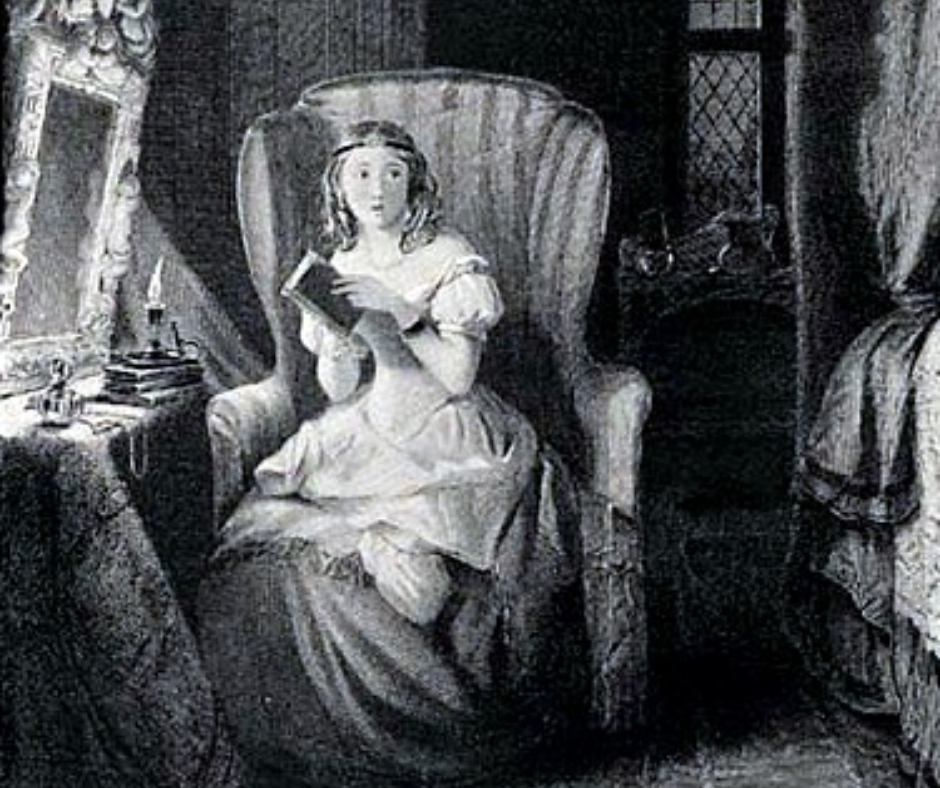
Hallmarks of gothic literature include secluded or ruined castles, dramatic emotions, and often supernatural elements. This illustration of Catherine reading was included in the 1833 Bentley Edition of Jane Austen’s Novels.
By mixing these models of reading, Austen auto-reflexively engages the audience as the novel illustrates the two ways in which the reader of Northanger Abbey may be interacting with the novel, logically or sensationally. Each person will naturally side with the character who represents their own personal reading style. Does the reader agree with Catherine Morland and recognize that something sinister might have happened at Northanger Abbey? Or does the reader take a more pragmatic view of matters, like Mr. Henry Tilney, and believe that bad things simply happen sometimes? There is not always a villain waiting in the wings and orchestrating the chaos.
What makes this auto-reflexive modeling effective is the mystery, as the author neither confirms nor denies what is logical or outlandish for the reader to believe. Who is to say whether it is ridiculous or perceptive to agree with the realization that General Tilney murdered Mrs. Tilney? This open-ended treatment of the subject allows each individual reader to both engage and reflect upon their reading style for themselves.
Unlike other critics of the gothic novel, Austen recognizes the genre’s faults, but then also posits that using one’s imagination and seeing more than is entirely present can be a practical way to view the world. To live a life of exclusive realism or sheer fancy does not provide a full scope of human experience. To conclude Northanger Abbey with the marriage of Catherine Morland to Henry Tilney is to end with the symbolic union of the sublime and realistic. It confirms that the mixed feelings evoked throughout the novel in conversations between these two main characters were both imaginative and rational––paradoxically both being necessary to navigate the world.
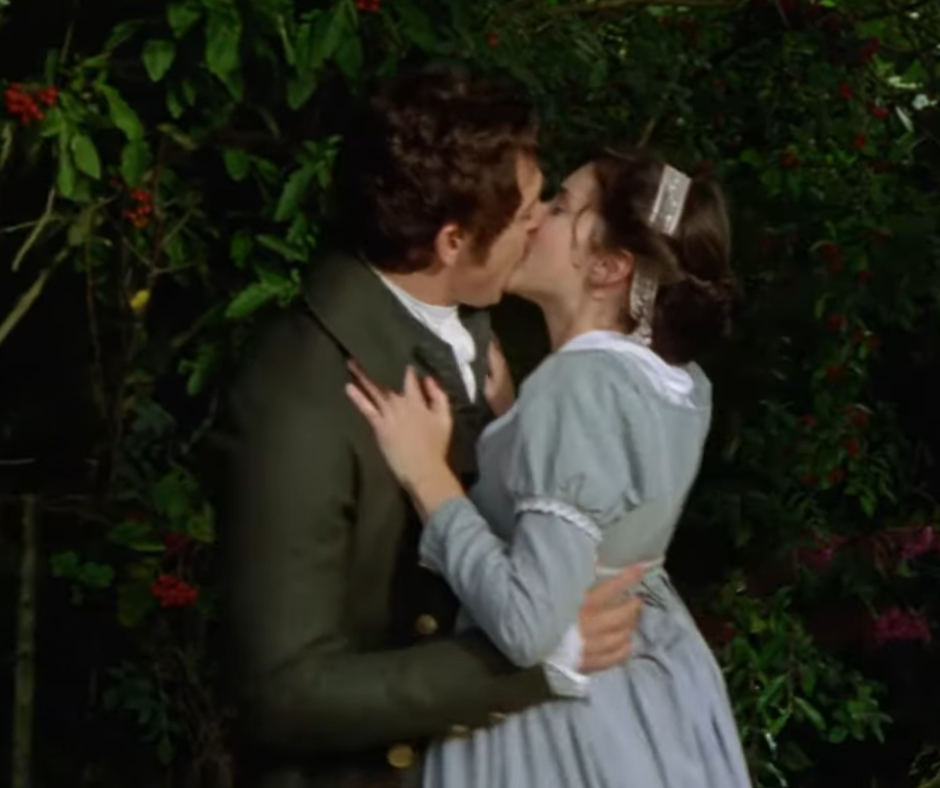
Readers Rejoice! Henry Tilney and Catherine Morland, despite their differences, find a way to appreciate and love one another. Ultimately, they make a good match and merge outlandish thinking with pragmatic.
Works Cited
Austen, Jane. “Northanger Abbey.” Northanger Abbey, Lady Susan, The Watsons and Sanditon. Edited by James Kinsley and John Davie, Oxford UP, 2008, pp. 5-187.
Britannica, The Editors of Encyclopedia. "The Mysteries of Udolpho". Encyclopedia Britannica, 10 Jan. 2022, https://www.britannica.com/topic/The-Mysteries-of-Udolpho.
Tanner, Julie. “The Legacy of Literary Reflexivity; or, the Benefits of Doubt.” Textual Practice,
Tylor & Francis Online, 17 Sept. 2021, www.tandfonline.com/doi/full/10.1080/0950236X.2021.1972038?scroll=top&needAccess=true.
Jessica Mancini
Jessica Mancini is a University of Oxford graduate student specializing in Romantic Literature, book history, and unconventional women’s print. She has presented and published original research and analysis at conferences in Canada, the U.S., and the UK, notably Harvard’s National Collegiate Research Conference, the Undergraduate Research Conference at the University of Toronto, and a forthcoming British Association of American Studies Symposium at Teesside University. Mancini has also published essays and fiction in literary magazines and academic journals. To read more about Jessica Mancini’s work, visit: jessicamancini.com.

🎭Jane Austen Improvised - A Fundraising Evening
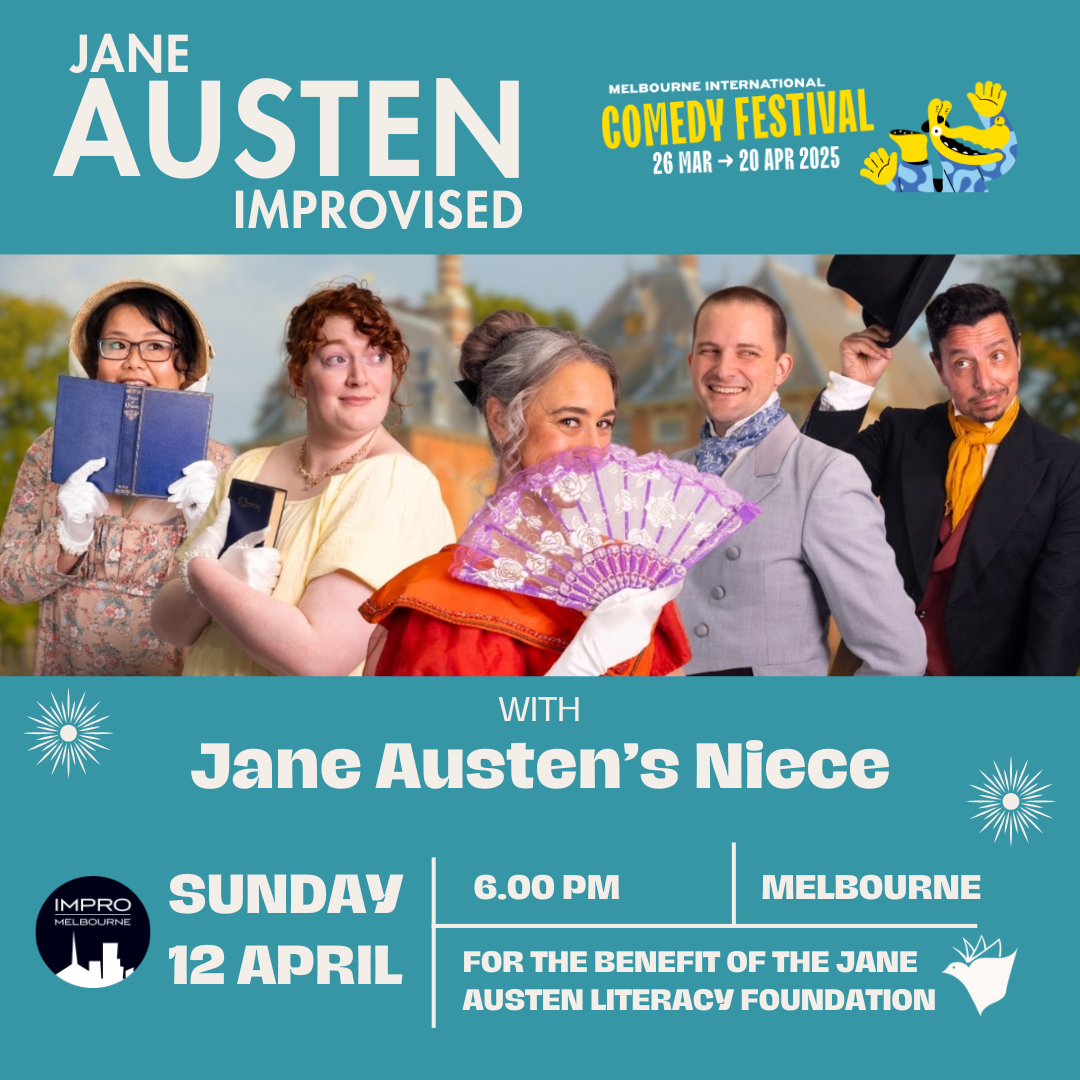
Join Caroline Jane Knight, Jane Austen's fifth great-niece and our Foundation founder, at Impro Melbourne’s Jane Austen Improvised at the Melbourne International Comedy Festival.
Caroline will share stories from her childhood at Chawton House and reveal Jane's surprising lifelong love of theatre — the born performer behind the novels. Profits from the evening go directly to the Jane Austen Literacy Foundation.
✨ When: Sunday 12 April
🕒 Time: From 6.00 PM
📍 Where: Impro Melbourne Theatre, West Melbourne
The Jane Austen Literacy Foundation Writing Competition 2026 is OPEN!
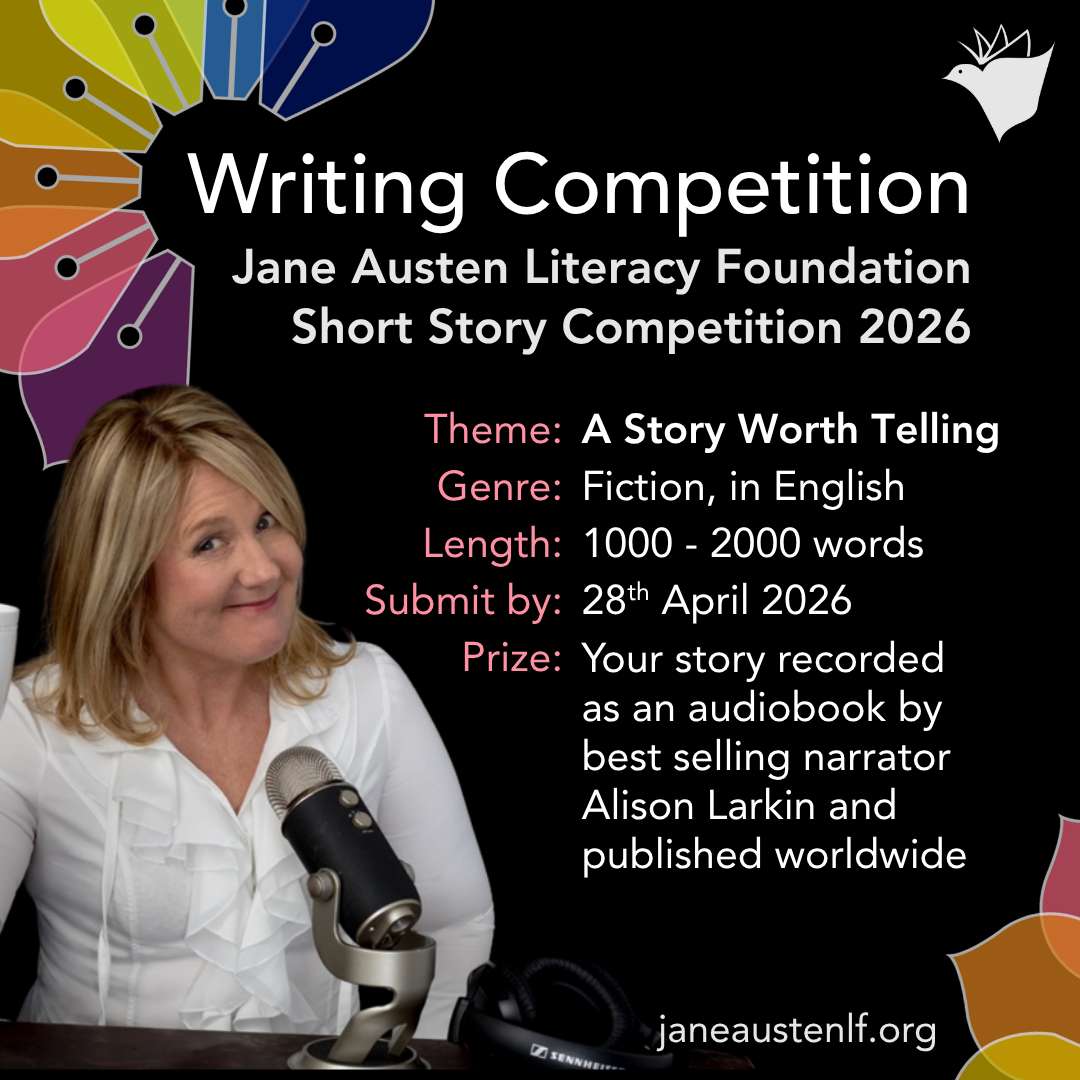
This year's theme is A Story Worth Telling — an open invitation to writers everywhere to put pen to paper and share the story only they can tell. Writers from over 30 countries entered last year. Whatever your experience, wherever you are writing from, you are welcome here.
The three winning stories will be recorded as an audiobook by best-selling Austen narrator Alison Larkin and published worldwide — and the overall winner will be announced at Chawton House, in the heart of Jane Austen's world.
Submissions close 28th April 2026. Find out more and enter here.
Our Community - What's Coming Up in April
Remember, your membership for only $10USD a month helps to support literacy programs around the world!
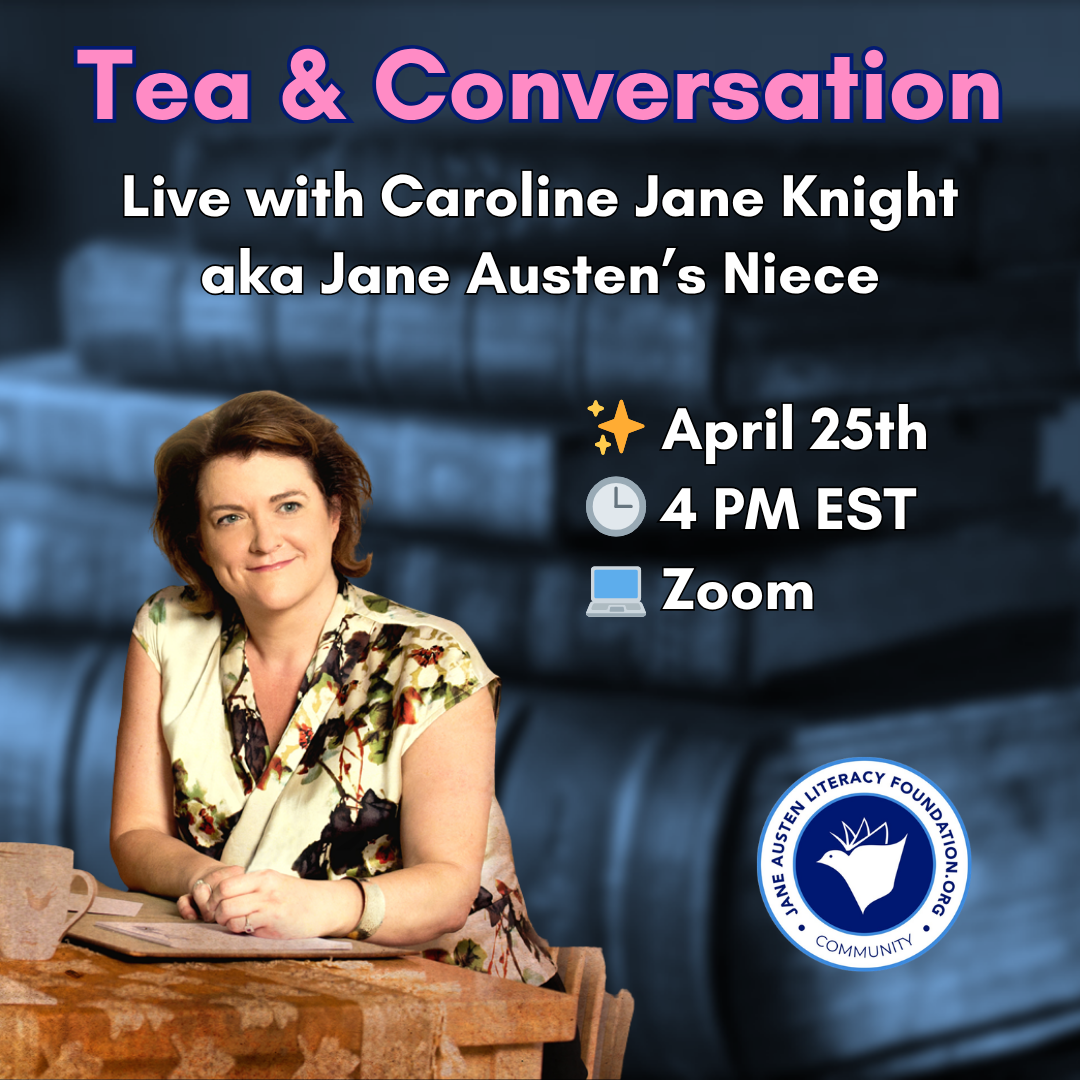
With our founder and chair, Jane Austen’s 5th great niece, Caroline Jane Knight.
Join Caroline to hear about some exciting plans for the Jane Austen Literacy Foundation and our Community. Plus, your chance to ask Caroline about the Foundation, her heritage preservation work, her childhood at Chawton House and anything else you’d like to know.
✨ When: Saturday 25 April
🕒 Time: 4.00 PM EST / 9.00 PM GMT
💻 Where: Zoom (link via email)