
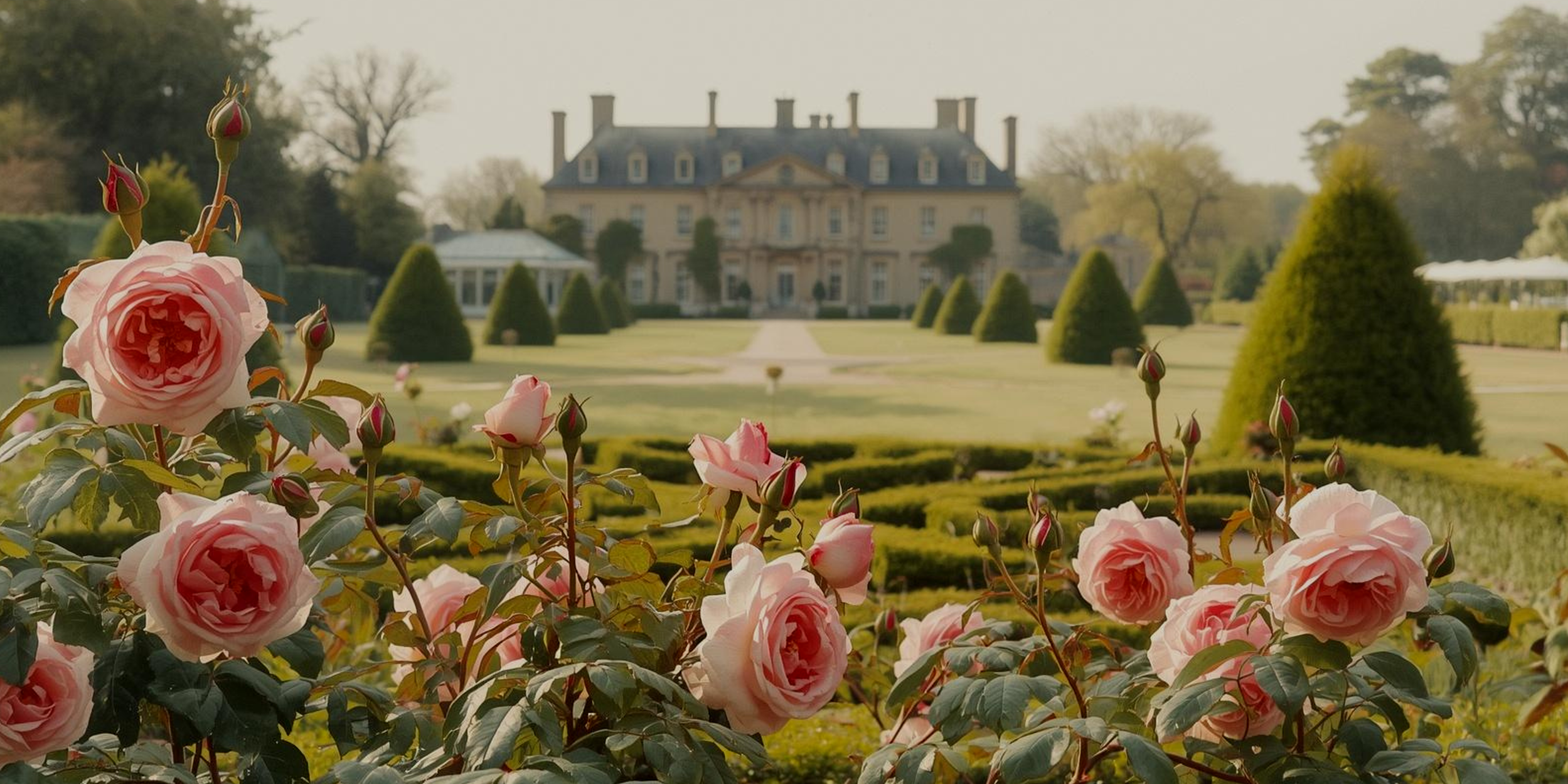
“[T]he garden is quite a love… I live in [Henry’s] room downstairs, it is particularly pleasant, from opening upon the garden. I go & refresh myself every now & then and then come back to Solitary Coolness.””
Award-winning author Kim Wilson takes a stroll through Jane Austen’s gardens and explores how nature, flowers, and spending a bit of time out of doors impacted Jane Austen and her famous characters.
Jane Austen grew up in the village of Steventon, Hampshire, in a quiet and pastoral landscape of ancient hedgerows and flower-filled meadows. Throughout her life, she showed a deep appreciation for nature, writing often to her sister, Cassandra, about her enjoyment of gardens and beautiful countryside views. Of the two surviving drawings that Cassandra made of Jane, one shows her sitting outside, gazing at nature. When the Austen family planned their move to the white-stoned city of Bath in 1801, Jane expressed her desire for a residence near greenery: “It would be very pleasant to be near Sydney Gardens! —we might go into the Labyrinth every day” (22 January 1801). And when the Austens moved from Bath to Southampton in 1806, she took a keen interest in the Austen family’s changes to the large garden at their new house in Castle Square. Jane wrote about the garden to Cassandra and seemed to have been just as interested in planting flowers and flowering shrubs and trees as in practical fruit bushes.
“Our Garden is putting in order,” she said, “by a Man who bears a remarkably good Character [and] has a very fine complexion… The Shrubs which border the gravel walk he says are only sweetbriar & roses, & the latter of an indifferent sort;—we mean to get a few of a better kind therefore, & at my own particular desire he procures us some Syringas. I could not do without a Syringa, for the sake of Cowper's line. We talk also of a Laburnum. The Border under the Terrace Wall, is clearing away to receive Currants & Gooseberry Bushes, & a spot is found very proper for Raspberries.”
— Letter from Jane Austen to Cassandra Austen, 8 February 1807

Modern visitors to Jane Austen’s House Museum might be greeted by a sight much like this one. Cheerful flowers and well-manicured shrubbery encourage patrons to take a long walk through the grounds, just as Jane Austen might have done. Photo courtesy of Sarah Clifton.
The line of poetry Austen refers to appears in The Task, by one of her favorite poets, William Cowper, who found great emotional solace in his garden, can be found here.
. . . These naked shoots,
Barren as lances, among which the wind
Makes wintry music, sighing as it goes
Shall put their graceful foliage on again,
. . . Laburnum, rich
In streaming gold; syringa, ivory pure;
The scentless and the scented rose; this red
And of an humbler growth, the other tall,
And throwing up into the darkest gloom
Of neighbouring cypress, or more sable yew,
Her silver globes, light as the foamy surf
That the wind severs from the broken wave
— William Cowper, The Task, 1785
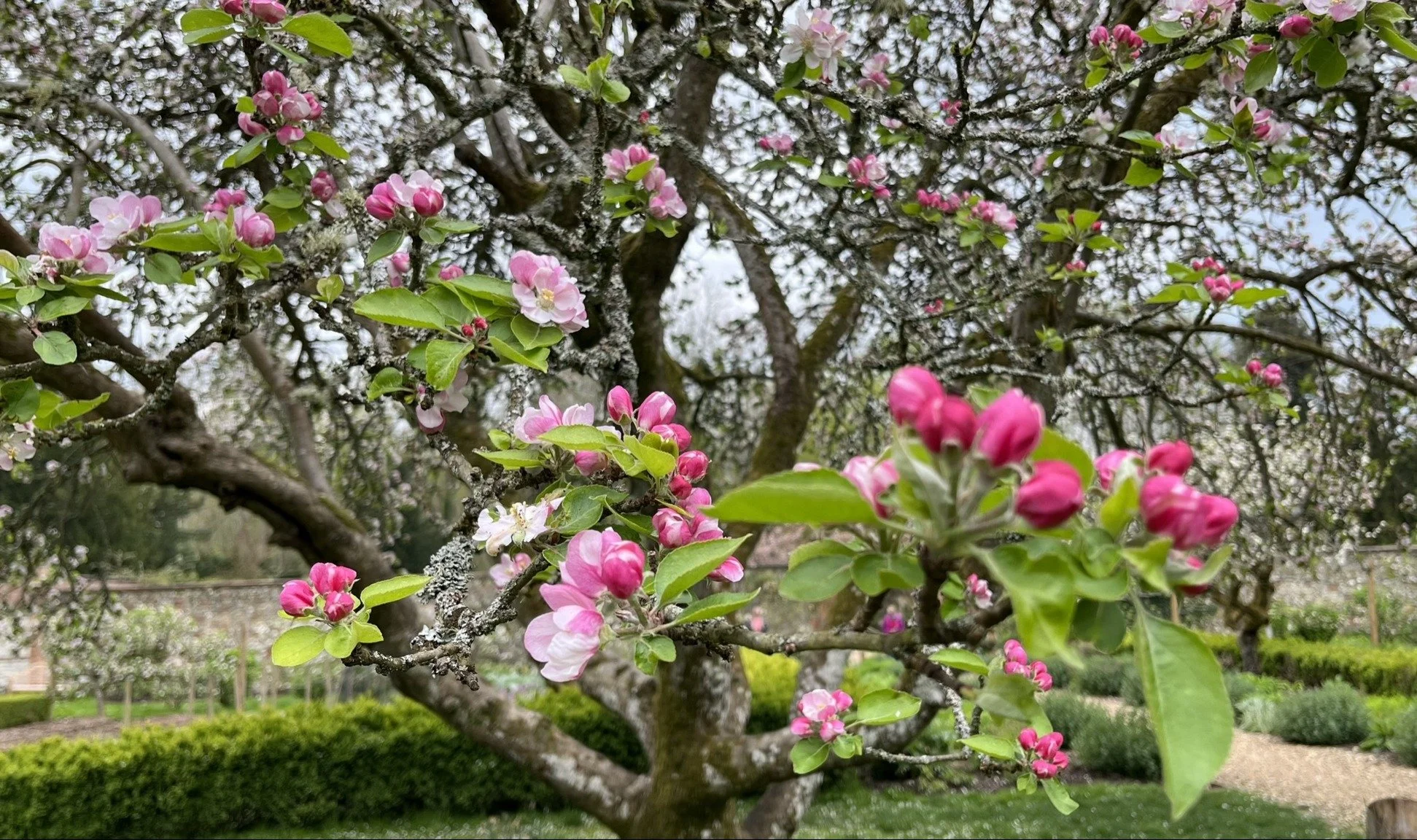
Get inspired, like Jane Austen, while peering out at the kitchen garden apple tree at Chawton Cottage. Even if you don’t fancy yourself a poet, like Cowper, the urge might strike to pen a verse or two. Photo courtesy of Sarah Clifton.
Modern gardeners might think that the syringa Jane Austen and William Cowper mention is a lilac, as Syringa is the Latin name for lilac today. But in Austen’s day, syringa usually meant mock orange, which is now called Philadelphus. The flowering tree “rich in streaming gold” is laburnum, the golden chain tree. I love that Jane Austen grew plants in her garden that made her think of her favorite poetry. Jane’s emotional response to her gardens evokes a feeling of connection to her, because we do the same today, choosing plants for our gardens that are not only useful or beautiful, but have emotional resonance for us. I was delighted when I moved to my current house and discovered that the side hedge was mock orange. Now when it blooms in the spring, I think of Jane Austen and her love of William Cowper’s poetry.
Since Jane Austen loved gardens and nature, it’s not surprising that her heroines and heroes do, too. Reading the novels, we notice that the good characters appreciate and love the outdoors, and the characters we love to hate do not. The characters of Mansfield Park are perfect examples. Fanny Price loves nature to the depths of her soul, and, like Jane Austen, is inspired by nature poetry. Mary Crawford, on the other hand, is carelessly indifferent to the beauties of nature, which should be enough to warn us about her dubious principles.

This mock orange tree can be found at Sydney Gardens in Bath. The sweet, citrusy smell lingers throughout the grounds. Photo courtesy of Kim Wilson.
For many of Jane Austen’s characters, gardens are more than a source of food or flowers; they are places of refuge and spiritual refreshment. As I examined the garden scenes in the novels, I particularly noticed what I like to think of as the “A Shrubbery of One’s Own” scenes.
"A woman must have money and a room of her own if she is to write fiction," Viginia Woolf wrote in A Room of One’s Own (1929). In Austen’s novels, nature provides the “room of one’s own” for her heroines, whose path to happiness with the spouse of their choice is never smooth. Beset by misunderstanding and misfortune, plagued by their parents and families, and overwhelmed by their emotional distress, they often find it difficult to find a quiet, private place just to sit and think over their problems. The reason for this is clear when we remember that life in a country house in Austen’s time was the opposite of private. In addition to the family, even the smallest of genteel households generally had at least one servant. The Austen women, never well off after Mr. Austen died, usually had a cook, a maid, and an outdoor man when they lived at Chawton Cottage, as do the Dashwood women at Barton Cottage in Sense and Sensibility.
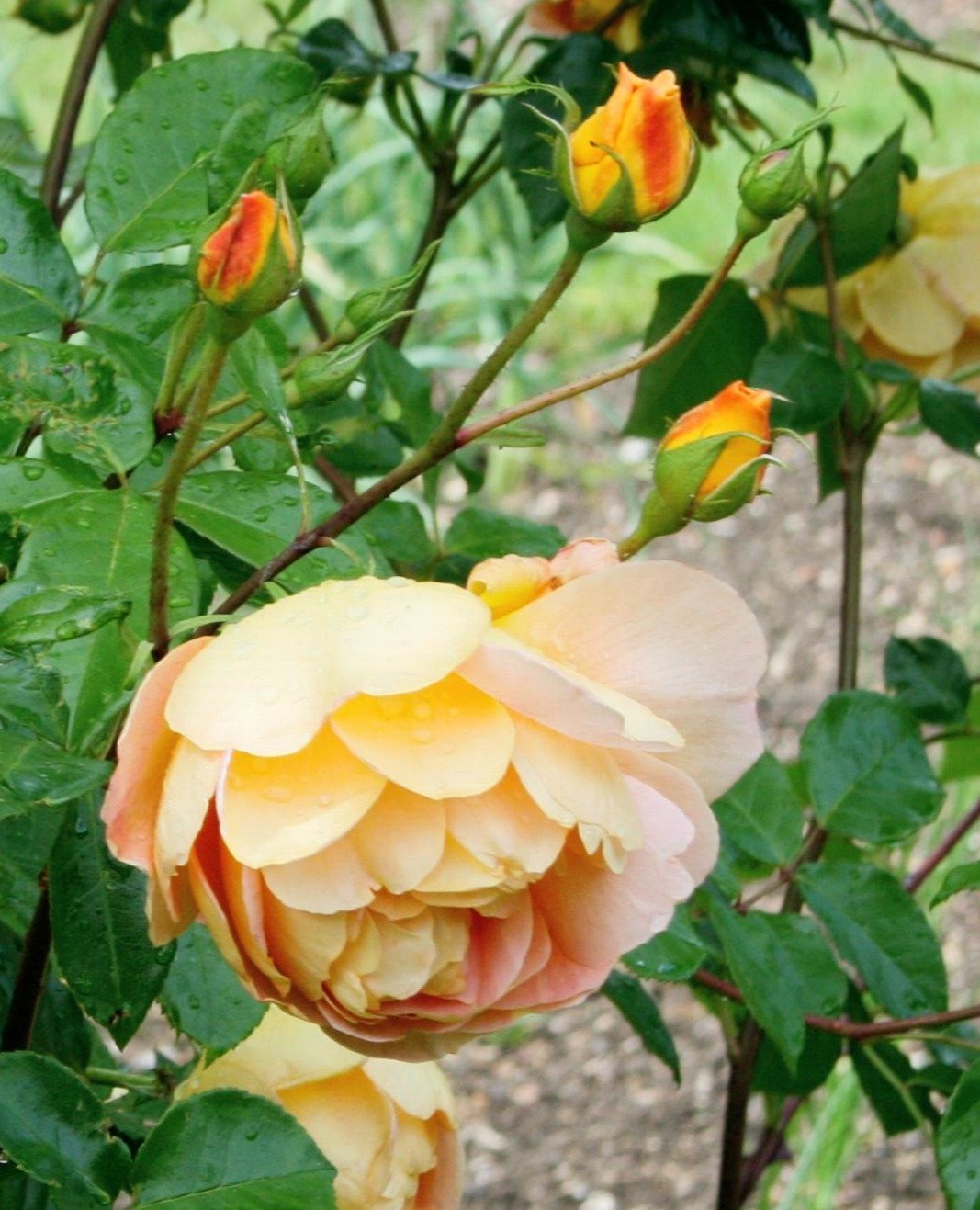
It requires only a small stretch of the imagination to picture Mr. Knightley presenting Emma with a bouquet of these David Austin Roses. These blooms grow right outside of Chawton House. Photo courtesy of Kim Wilson.
Nearly every one of the heroines takes refuge at some point in the novels in the gardens and grounds of their houses to gain privacy or to “indulge” (a word Jane Austen often uses in connection with introspective feelings) in their emotions. In Pride and Prejudice, Elizabeth and Jane Bennet often walk in the shrubbery at their estate, Longbourn, when they want to get away from their family and speak privately. Elizabeth Bennet walks in the groves of Rosings to ponder Darcy’s letter, Marianne Dashwood pines over the worthless Willoughby in the wilder parts of the grounds of Cleveland in Sense and Sensibility, Fanny Price finds what Austen calls “animation, both of body and mind” in the gardens of Mansfield Park, and Emma soothes her nerves with a walk in the shrubbery at Hartfield.
Many of the important romantic scenes in the novels take place in the garden or outdoors. The pleasure grounds of a country estate, filled with winding paths and secret nooks, form perfect settings for the lovers in Jane Austen’s novels. In Austen’s time, unmarried young women and men were not supposed to be left alone together, which rather limited their ability to do more than engage in publicly acceptable conversation and exchange tender glances. But opportunities to converse and cuddle, so scarce indoors, could easily be found in the garden under the guise of the socially acceptable walk. Jane Bennet and Charles Bingley escape to walk alone in the shrubbery in Pride and Prejudice when visitors arrive, Fanny Price and Edmund Bertram fall in love "wandering about and sitting under trees . . . all the summer evenings" at Mansfield Park, Mr. Knightley proposes to Emma in the shrubbery, and in Pride and Prejudice, Darcy proposes for the second, successful, time to Elizabeth Bennet as they walk from the Bennets' estate to a neighboring house. Indeed, most of the successful proposal scenes in the novels take place out of doors, showing that Jane Austen knew well how necessary to love privacy was. In the garden, her heroines find privacy, love, and perhaps most important, physical and emotional refreshment, as Jane herself did in her own gardens.
"I shall soon be rested," said Fanny; "to sit in the shade on a fine day, and look upon verdure, is the most perfect refreshment."
— Mansfield Park
Kim Wilson
Kim Wilson is the award-winning author of Tea with Jane Austen, In the Garden with Jane Austen, At Home with Jane Austen, and the upcoming Entertaining Mr. Darcy. A popular speaker on Jane Austen, food history, and garden history, she enjoys helping modern audiences discover the pleasures of everyday life in the Regency era.

Congratulations to our Writing Competition Winner 2026!

2026 Winner: Kailum Graves
We're delighted to announce that Kailum Graves is the winner of our 2026 Writing Competition, chosen by public vote for his wonderful story The Woman Who Borrowed Other People's Endings.
Kailum is a Brisbane-based writer whose work blends speculative fiction, humour, grief and the strange tenderness of being human. As always, our finalists were judged blind, then read and voted for by the public — so this win was truly earned on the page.
Congratulations, too, to our runners-up, McLord Selasi Azalekor and Olive Shaw. All three stories will be recorded as an audiobook by Austen narrator Alison Larkin.
Click below to find out more about Kailum and our finalists.
Our Community - What's Coming Up in August

Jane Austen Quiz — Live with Caroline Jane Knight
Test your Austen knowledge and win money-can't-buy prizes, including signed books! Join Caroline for a lively, light-hearted live quiz — a fun way to celebrate Jane and spend an hour in good company.
✨ When: Saturday, 22nd August
🕒 Time: 3 PM EST / 8 PM UK
💻 Where: On Zoom
Friends of the Foundation will receive the Zoom link by email.
Become a Friend of the Jane Austen Literacy Foundation. For just US$10 a month, you'll support our literacy work around the world and enjoy optional monthly events like this one.